How it works
From scattered data to a daily edge.
Indaga runs the same class of open-source tools and public scientific databases that academic labs use — assembled into one engine and run on our server in the Netherlands (EU).
Step 1 — what you bring
Start with the file you already have.
Tens of millions of people already took a DNA test and never got much from it. Bring that raw file — no new kit. Connect your Watch and glucose whenever you like, and type in blood results as you get them; each one makes the picture sharper.
DNA file
23andMe · MyHeritage · AncestryDNA · FamilyTreeDNA
Wearable
Apple Watch · sleep · HR · HRV
Glucose
Dexcom / CGM sessions
Blood panels
entered by hand · value, lab, range
- 23andMeraw data (.txt / .zip)
- MyHeritageraw DNA export
- AncestryDNAraw DNA export
- FamilyTreeDNAraw DNA export (.csv.gz)
Step 2 — what happens to your DNA
From a raw file to an honest genome.
Your DNA file is aligned; common variants your chip didn’t measure are estimated from a reference panel and marked as such; then it is indexed and interpreted with the same open databases and methods clinical labs use, queried from our own copies. Every step is built to know the difference between “benign” and “we never measured it.”
At a glance
Every step runs on our server in the Netherlands
Your genome · start to answer
- 01
What you bring
Your DNA file
The file you already have: a raw-data export from 23andMe, AncestryDNA, MyHeritage or FamilyTreeDNA. You upload it once, and it is stored encrypted on our server in the Netherlands (EU).
- 02
Align
Matched to the modern genome
Your file is lifted onto the current reference build so it lines up with today's clinical databases.
- 03
Impute
Common variants estimated
A chip reads only a fraction of your genome. Common variants your chip didn't measure are estimated from a reference panel (imputation); estimated readings are marked as such.
- 04
Index
Turned into a queryable genome
Every position carries its callability. If a spot was never read, it is marked not measured — unknown, never “you don't have it.”
- 05
Annotate
Interpreted — every source named
A check of rare variants against ClinVar, the public database that links variants to health conditions; not a diagnosis, and on a chip most of it is “not read”. Polygenic scores from the PGS Catalog and published trait studies add context across many variants, each with its source.
ClinVarPolygenic scoresGWAS - 06
Answer
Queried, and answered honestly
Every answer carries a finding state and a readiness — and refuses to guess about what wasn't measured. Your genetics fuse with your labs, glucose and wearable, so a risk allele is read against your real numbers.
The whole pipeline runs on our server in the Netherlands (EU). Reference databases are downloaded once and queried in-house, so your variants are never looked up in someone else’s database.
The model
A high-frequency loop on a deep foundation.
The long record supplies context; the app turns today’s wearable and sleep signals into one useful next step.
Daily loop · high-frequency
Healthlake foundation · low-frequency
The four stages
Connect, pulse, synthesize, optimize.
- 01
Connect & ingest
Bring the DNA file you already have, connect your Watch and CGM, and type in your blood results. Everything is structured into your private Healthlake, on our server in the Netherlands.
- 02
Daily pulse
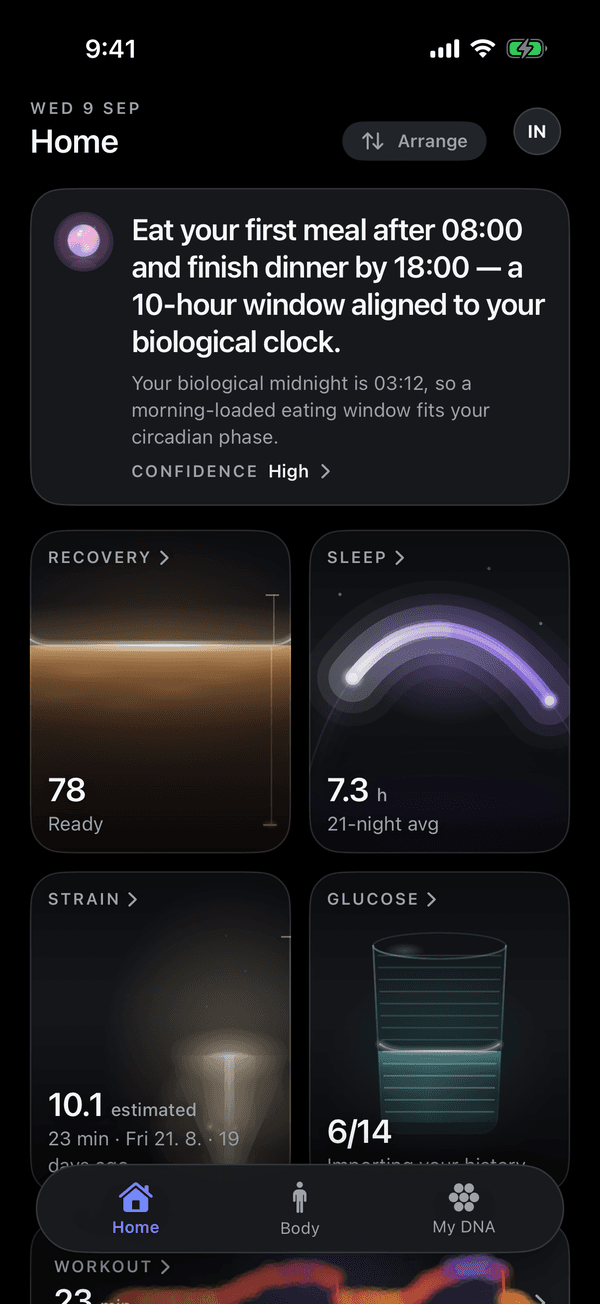
Each morning your sleep and activity update your Biological Clock and locate your Biological Midnight, using a validated 2025 cosinor heart-rate method.
- 03
Deep synthesis
Your DNA, bloods and wearable history are assembled into one grounded, cited answer — each finding carrying its own evidence grade and its own caveats, so the “why” arrives with its uncertainty attached rather than sanded off.
- 04
Optimize
You get today’s levers, the contextual glucose view, an ask-anything explorer, and a doctor-ready letter for your next visit. Every claim traces to a named source.
Every claim traces back to a named public source — and to a record in your own Healthlake. If you want to check our work, you can.
Indaga is in active development.
We’re building it privacy-first, cited, and honest about what it can and can’t see.