Science
Trustworthy because it shows its work.
This category has a credibility problem because its claims can’t be checked. Ours are built to be.
Reproducible
Built on open-source bioinformatics tools and public, peer-reviewed databases — not a proprietary black box.
Cited
Every claim traces to a named source, and to a specific record in your own Healthlake.
Calibrated
The biggest failure in consumer health-tech is false precision. We use directional, honest language and show the uncertainty.
Cross-validated
High-impact findings must hold up across independent checks before they reach you. We’d rather drop an uncertain finding than alarm you with a false one.
Indaga’s engine is open source — you can read it, run it, and check our work. View it on GitHub →
Calibrated, not alarming
The same finding, told two ways.
A typical consumer report
Your risk is HIGH
“3× more sensitive”
The same finding, in Indaga
Modestly above average — about 1.3×, driven by 18 common variants with small individual effects.
Two positions weren’t callable from your chip — noted, not glossed over.
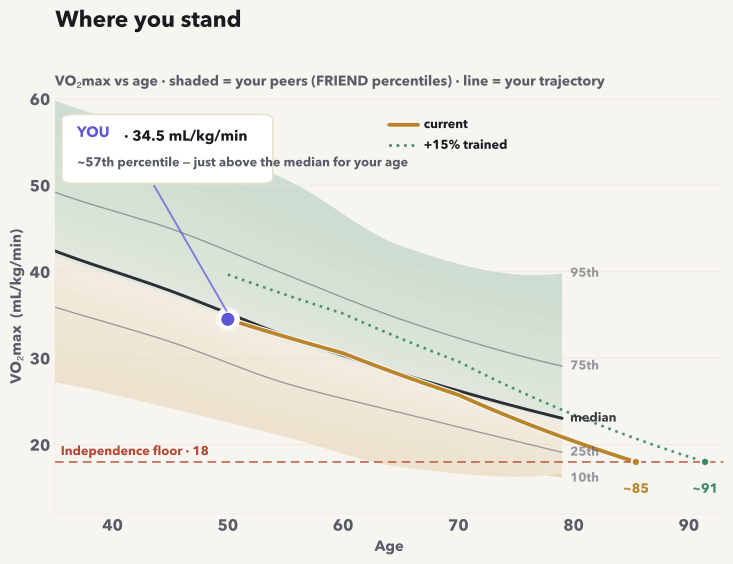
Where you stand
A percentile is a band, not a false-precise number.
Your VO₂max — the most modifiable predictor of how long you stay independent — on directly-measured peer norms (the ACSM FRIEND registry). You’re a position inside a band, not a single decimal; and your trajectory toward the point where everyday tasks get hard is drawn, not asserted — labelled a projection, not a prediction.
The calibration mechanism
Gates that fail the build, not a second opinion from another model.
The usual answer to AI overstatement is more AI — a reviewer model asked to criticise the first one. We went the other way. These checks are deterministic, they run on every release, and they are the reason a finding gets withheld rather than softened. A gate you can read is worth more than a critic you have to trust.
- 01
The envelope
Every answer carries its own evidence grade, and that grade is computed once — at the source. Nothing downstream may re-derive it, round it up, or drop it in transit.
- 02
The zero-data sweep
Before each release, every read is run against a subject the engine knows nothing about. If any of them still says something about that person, the build fails.
- 03
Four different silences
Not measured, still calibrating, gone stale and actually known are four separate answers. Absence never renders as a quiet “you're fine”.
Built in the open
It’s real software. Read it, run it.
Indaga’s engine is open source and runs entirely on your machine — bring the DNA file you already have, and ask your own agent. Every capability on this site maps to that engine. If it’s listed, it runs.
View the engine on GitHub →$ indaga impute --subject me --chip 23andme_raw.txt$ indaga annotate --subject me# then ask your own agent — locally:› any ACMG-actionable secondary findings?› am I a slow caffeine metabolizer?cited, calibrated, honest about what your chip could see.
We show the uncertainty because hiding it would be the dishonest thing.
Absence is never “normal.” A test you never took returns “not measured,” not “you’re fine.” That single rule is the reason the product exists.
Indaga is in active development.
We’re building it in the open — privacy-first, cited, and honest about what it can and can’t see.